Proudly serving Phoenix, Scottsdale, Glendale, Tempe, Mesa, Chandler & surrounding areasCall or Text 24/7: 480-264-9683
Aerial drone view of a suburban residential neighborhood with desert landscaping and saguaro cacti in Phoenix, AZ.

Epoxy Flooring Coatings & Concrete Protection in Phoenix, AZ

Phoenix Expert Flooring installs two-part epoxy flooring for homes and businesses across Phoenix and the surrounding metro. Our epoxy services include garage floors, commercial facilities, warehouses, decorative coatings, and residential concrete spaces. We also provide flooring installation, luxury vinyl plank, tile, hardwood, laminate, carpet, floor repair and replacement, hardwood refinishing, and commercial flooring. We match each epoxy recommendation to the slab, traffic, chemical exposure, and finish goals.

Phoenix concrete faces intense surface heat, thermal cycling, hot tire pickup, UV exposure, and monsoon moisture. We test slab moisture per ASTM F1869 before material goes down. Surface preparation follows International Concrete Repair Institute guidance, with mechanical grinding or diamond shot blasting instead of acid etching. Clients can request a free on-site assessment and written quote before choosing a system.

Our crews use industrial-grade, two-component epoxy resins, and we hold current Arizona Registrar of Contractors licensing. Our low-VOC formulations meet Arizona Department of Environmental Quality air quality standards for the Maricopa County nonattainment area.

Phoenix Expert Flooring provides epoxy flooring throughout Phoenix and the surrounding metro, including Scottsdale, Tempe, Mesa, Chandler, and Glendale.

★ ★ ★ ★ ★4.9/5 Average Rating · 20+ Years of Experience · Thousands of Customers Helped · Licensed & Insured · Residential & Commercial

Phoenix Epoxy Flooring Benefits

What Is Epoxy Flooring?

Epoxy flooring is a two-part resin system that bonds chemically into prepared concrete instead of sitting on top like paint. The result is a seamless surface built to resist abrasion, chemicals, and heavy use.

A complete system can combine a moisture-mitigation primer, self-leveling epoxy base coat, broadcast flake or quartz, and a polyurethane or polyaspartic topcoat. The layers are selected around slab conditions and how the finished floor will be used.

Epoxy can serve garages, workshops, warehouses, healthcare and food service areas, showrooms, sunrooms, laundry rooms, and other concrete spaces. Finish options range from colored flake and quartz to metallic patterns with high-gloss, semi-gloss, or matte topcoats.

Benefits of Epoxy Flooring

A properly specified epoxy system turns porous concrete into a durable, cleanable surface while allowing the appearance and traction level to suit the space.

  • Resists abrasion, chemicals, oil, brake fluid, and pool chemicals
  • Handles hot tire pickup and demanding vehicle traffic
  • Creates a seamless, waterproof, non-porous surface
  • Offers colored, flake, quartz, and metallic designs
  • Accepts aluminum oxide or polymer grit for added slip resistance
  • Uses polyurethane or polyaspartic topcoats for UV and scratch resistance
  • Supports routine cleaning without grout lines
  • Can be specified for residential, commercial, or industrial loads
Epoxy Flooring Services

Epoxy Flooring Services

We tailor epoxy resin chemistry, build thickness, broadcast media, traction, and finish to the property's slab conditions and daily use.

Garage Epoxy Flooring

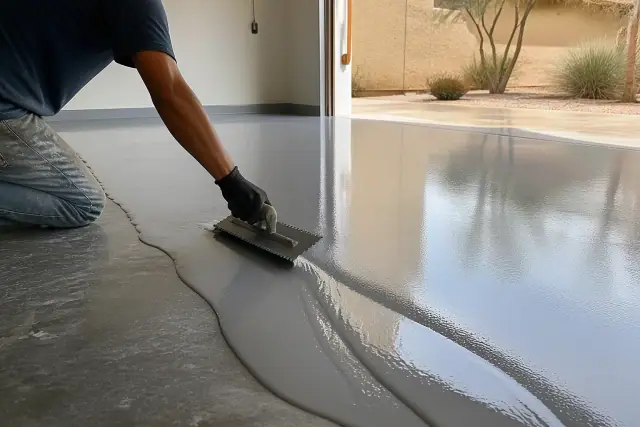
Professional applying high-gloss epoxy resin to a concrete garage floor at a residence in Phoenix, AZ.

Garage systems protect porous concrete from oil, brake fluid, pool chemicals, road residue, dusting, and hot tire pickup. Flake or quartz media and a durable topcoat create a cleanable floor suited to Phoenix vehicle traffic.

Request Estimate

Commercial Epoxy Flooring

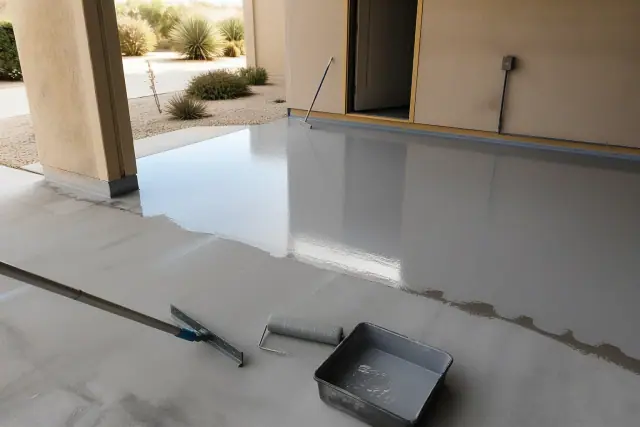
Contractor applying fresh high-gloss epoxy resin to a concrete floor at a jobsite in Phoenix, AZ.

Commercial epoxy systems are selected for rolling loads, chemical exposure, abrasion, sanitation needs, and required traction. We coordinate with facility managers on off-hour installation schedules to reduce downtime in occupied buildings.

Request Estimate

Warehouse & Industrial Epoxy

Glossy industrial epoxy flooring installed on a warehouse concrete slab in Phoenix, AZ.

Warehouses and manufacturing floors can require high-build, trowel-applied, or self-leveling systems for forklifts, pallet jacks, heavy oils, and steel-rack point loads. Resin chemistry is chosen around the facility's documented exposures.

Request Estimate

Healthcare & Food Service Epoxy

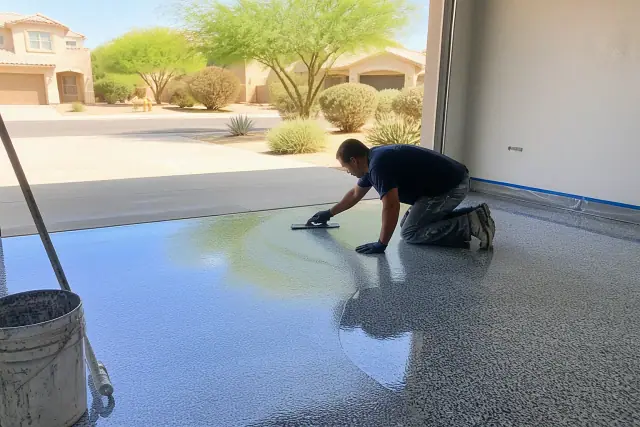
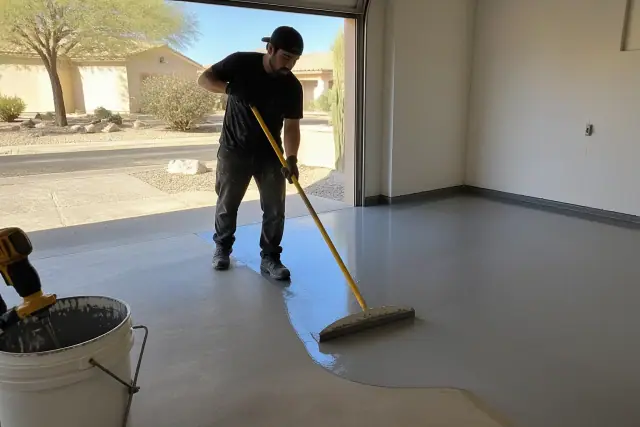
Worker using a squeegee to apply glossy epoxy resin to a concrete garage floor in Phoenix, AZ.

Non-porous epoxy with an integral cove base reduces bacterial harborage and supports sanitation in healthcare and food service spaces. Slip resistance can be built into the system to address OSHA walking-working surface requirements.

Request Estimate

Decorative & Metallic Epoxy

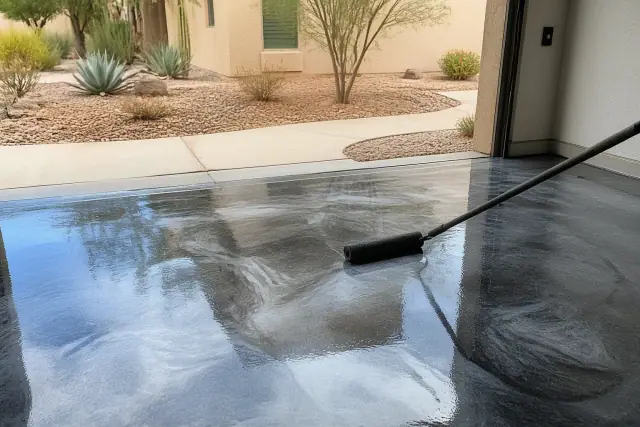
Contractor applying metallic epoxy resin to a garage floor in Phoenix, AZ with a xeriscaped yard in the background.

Metallic pigments create marbled, three-dimensional patterns for showrooms, luxury garages, and retail buildouts. Colored epoxy, vinyl flake, and quartz blends offer additional ways to coordinate the floor with a home exterior or business palette.

Request Estimate

Residential Interior Epoxy

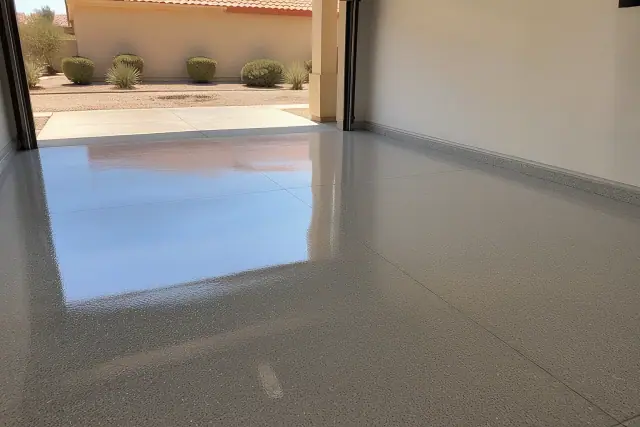
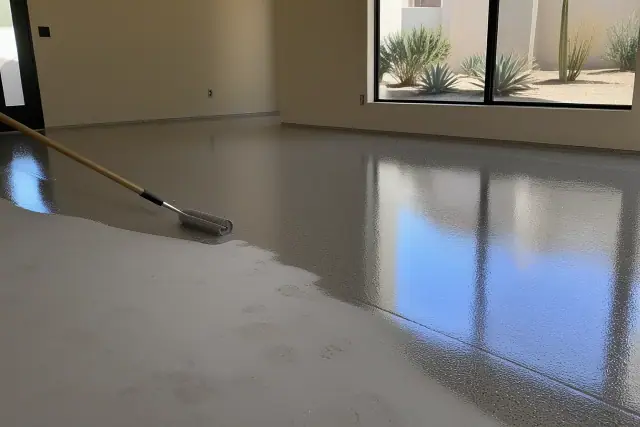
A high-gloss residential epoxy floor installation in Phoenix, AZ, with sunlight showing through a nearby window.

Epoxy can cover slab-on-grade or below-grade concrete in basements, sunrooms, laundry rooms, mudrooms, and pool-adjacent interior spaces. Vapor-barrier options and UV-stable topcoats address moisture and direct desert sunlight where those conditions apply.

Request Estimate
Coating & Finish Options

Types of Epoxy Flooring Options

System selection depends on use, traffic, chemicals, slab moisture, appearance, and traction. These options can be configured around residential, decorative, commercial, and industrial needs.

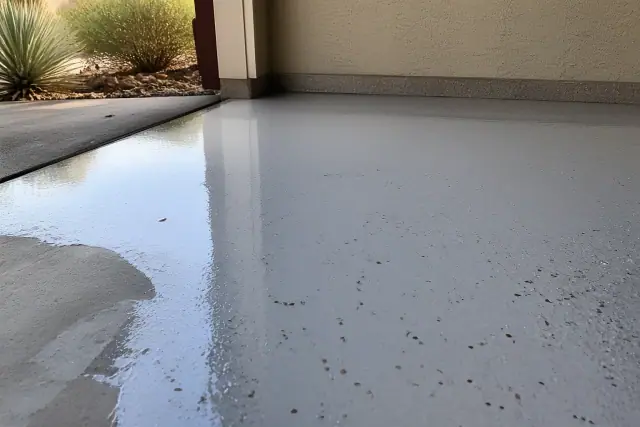
Freshly applied flake epoxy flooring on a garage concrete surface in Phoenix, AZ, with desert landscaping in the background.

Standard Flake Epoxy Systems

A flake system combines a prepared slab, two-component epoxy base, vinyl flake broadcast, and protective topcoat for a durable garage or utility floor.

  • Two-component, self-leveling epoxy base coat
  • Vinyl flake blends in dozens of color combinations
  • Partial or full-saturation broadcast
  • Polyurethane or polyaspartic protective topcoat
  • High-gloss, semi-gloss, or matte finish
Request Estimate
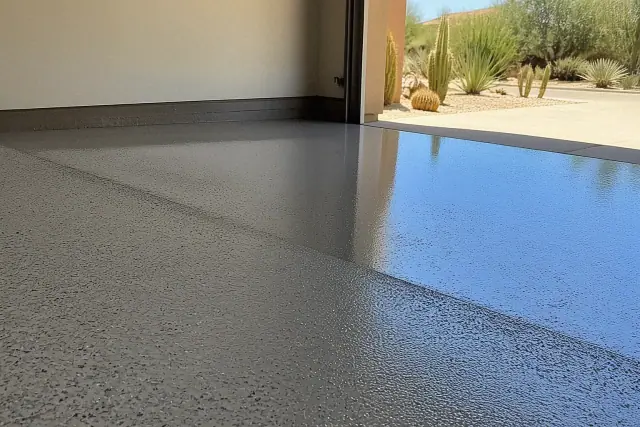
Quartz broadcast system being applied to fresh epoxy on a garage floor in Phoenix, AZ.

Quartz Broadcast Systems

Quartz media can be broadcast into the epoxy to full saturation for a heavier-duty surface with added texture in garages, pool decks, ramps, and commercial entries.

  • Full quartz broadcast for heavier-duty use
  • Textured surface for added traction
  • Colored quartz design options
  • Suitable for ramps, entries, and pool areas
  • Sealed beneath a durable protective topcoat
Request Estimate
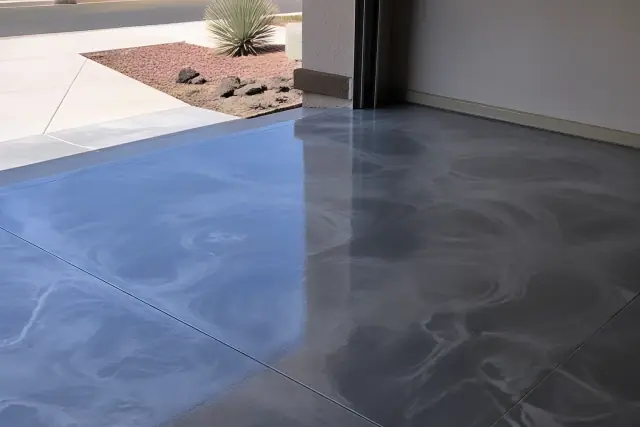
Glossy metallic epoxy garage floor with swirl patterns in a Phoenix, AZ home, featuring xeriscape landscaping.

Metallic Epoxy Floors

Mica-based pigments are folded into the resin during application to create marbled, three-dimensional movement that resembles polished stone.

  • Mica-based pigments blended into the resin
  • Marbled, three-dimensional appearance
  • Multi-color custom blending
  • Popular for showrooms, luxury garages, and retail
  • Detailed topcoat finishing
Request Estimate
Industrial equipment for prepping a garage concrete floor at a jobsite in Phoenix, AZ.

Chemical-Resistant Industrial Systems

Industrial builds may use trowel-applied or self-leveling epoxy mortar in the 3/16 to 1/4 inch range, with novolac epoxy or specialized topcoats selected for documented chemical exposure.

  • Novolac epoxy for demanding chemical exposure
  • Resistance to solvents, acids, and heavy oils
  • High-build epoxy mortar construction
  • Designed for forklift and pallet-jack traffic
  • Supports steel-rack point loads
Request Estimate
Contractor applying a matte polyurethane topcoat to a concrete garage floor in Phoenix, AZ.

Polyurethane & Polyaspartic Topcoats

A polyurethane or polyaspartic topcoat protects the epoxy base from UV exposure, abrasion, scratching, and hot tire pickup while setting the desired sheen and traction.

  • Improves UV stability in sun-exposed spaces
  • Adds scratch and abrasion resistance
  • Helps resist hot tire pickup
  • Available in high-gloss, semi-gloss, or matte
  • Can include aluminum oxide or polymer grit
Request Estimate
Finding Your Right Fit

Choosing the Right Epoxy Flooring Approach

The right system depends on square footage, concrete condition, moisture, traffic, chemical exposure, sanitation needs, sunlight, traction, finish, and budget. An on-site slab assessment lets us match preparation, resin, broadcast media, and topcoat to the space rather than prescribing one coating for every property.

ICRI-Guided Surface Preparation

We mechanically grind or diamond-shot-blast each slab instead of relying on acid etching. Preparation targets a CSP 3 profile under International Concrete Repair Institute guidance so the epoxy can bond to open concrete pores.

ASTM F1869 Moisture Testing

We test slab moisture per ASTM F1869 before coating. Where vapor conditions call for it, the specified build can include a moisture-mitigation or vapor-barrier primer.

Licensed, Low-VOC Installation

Phoenix Expert Flooring holds current Arizona Registrar of Contractors licensing. Our low-VOC epoxy formulations meet Arizona Department of Environmental Quality air quality standards for the Maricopa County nonattainment area.

What Sets Us Apart

Why Choose Us for Epoxy Flooring Installation?

Our quotes break down the material system, square footage, and preparation scope so clients understand what they are paying for and why. We have applied epoxy in Phoenix-area residential garages, property-managed commercial garages, showrooms, retail spaces, and warehouse floors near Sky Harbor.

Get a Free Assessment

Extreme Slab Heat

Unprotected garage and driveway concrete in the Salt River Valley regularly climbs past 140 degrees in summer. Repeated thermal cycling can contribute to pitting, dusting, and cracking.

Moisture Vapor

Moisture moving through a slab can cause blistering or delamination when it is not identified before installation. Summer monsoon humidity can also extend recoat windows, so testing and scheduling matter.

Hot Tire Pickup

Hot vehicle tires can soften and lift thin coatings that merely sit on the slab. West-facing UV exposure can also yellow cheaper coatings within a season or two without a stable protective topcoat.

Cracks and Spalling

Bare concrete can pit, dust, crack, and spall within a few years under Phoenix heat, moisture, and use. Existing cracks and control joints must be evaluated and patched as part of the preparation scope.

Oil and Chemical Stains

Porous garage concrete absorbs oil, brake fluid, pool chemicals, and cleaners. Oil saturation and chemical exposure affect preparation needs and the resin chemistry selected for the finished floor.

Premature Peeling

Correct preparation can separate a floor that lasts 20 years from one that fails in 18 months. Floors coated after acid etching instead of mechanical preparation are especially prone to peeling and delamination within a year or two.

How It Works

Our Epoxy Flooring Process

Every installation follows a disciplined sequence from slab assessment through final cure. Each step supports adhesion, durability, appearance, and the return-to-service schedule.

01.

On-Site Slab Assessment

We inspect the concrete for moisture intrusion, existing coatings, oil saturation, structural cracking, control joints, traffic, and chemical exposure before specifying the build.

02.

Moisture Testing

Slab moisture is tested per ASTM F1869. The results determine whether the system needs a moisture-mitigation primer or vapor-barrier option.

03.

Mechanical Surface Preparation

Diamond grinding or shot blasting opens the concrete pore structure and targets a CSP 3 profile. This creates the mechanical bond that acid etching alone does not provide.

04.

Crack Repair and Priming

We patch cracks and control joints, address oil-stained areas, and apply the specified primer. Moisture mitigation is included where vapor testing calls for it.

05.

Base Coat and Broadcast

A self-leveling epoxy base coat is applied, followed by decorative flake or quartz media at the specified broadcast level. Metallic systems receive their pigment blending during this stage.

06.

Protective Topcoat and Cure

A polyurethane or polyaspartic topcoat provides the specified UV, abrasion, sheen, and traction performance. We set the return-to-service schedule around the system, temperature, humidity, and intended use.

Plan Your Epoxy Floor

Schedule an Epoxy Flooring
Assessment

Request a free on-site assessment for your Phoenix garage, residential concrete space, commercial facility, or industrial floor. We will review slab condition, use, finish goals, and preparation needs before providing a written quote.

Epoxy Flooring Help

Phoenix Epoxy Flooring FAQs

Get practical answers about Phoenix epoxy flooring prices, preparation, finish options, performance, and cure times.

Call Our Epoxy Team

A 1,500 square foot standard two-coat epoxy system in Phoenix typically costs $6,000 to $10,500 installed, based on the common $4 to $7 per square foot range. Metallic or fully custom decorative systems at that size generally run $10,500 to $13,500, reflecting the typical $7 to $9 per square foot range. Existing slab condition and design complexity affect the final quote.

Epoxy requires correct surface preparation, can be slippery when wet without a traction additive, and may chip or crack if the underlying slab shifts or heavy equipment is dropped on it. The space also has a cure and off-gas period before full traffic resumes. Mechanical preparation, moisture testing, and a suitable topcoat help prevent avoidable failures.

Epoxy is generally more affordable for garages, workshops, and commercial concrete once labor, underlayment, grout, and maintenance are considered. Its seamless surface also avoids grout lines that trap oil and grime. Tile may still suit kitchens and bathrooms where comfort and traditional residential appearance matter more than chemical or vehicle resistance.

A typical two-car garage of 400 to 600 square feet usually costs $1,600 to $4,200 for a professionally installed standard system at $4 to $7 per square foot. Heavy-duty full-quartz or metallic options often reach $5,000 to $7,000. Extensive crack repair, oil removal, or moisture mitigation can add to the price.

A properly installed epoxy system can hold up for 10 to 20 years with routine cleaning. Actual service life depends on slab movement, preparation, resin system, topcoat, UV exposure, chemicals, and traffic.

Most systems allow foot traffic within 24 hours and vehicle traffic within 3 to 5 days. Full chemical cure for heavy industrial use typically takes 7 days. Phoenix's low humidity often speeds curing, while summer monsoon moisture can extend recoat windows.

The slab should be assessed, moisture tested, mechanically ground or shot-blasted, and repaired before priming. We target a CSP 3 surface profile under ICRI guidance. Acid etching alone is a leading cause of premature delamination because it does not create the same mechanical profile.

Options include full-spectrum colored epoxy, vinyl flake blends, quartz broadcast systems, and mica-based metallic designs in dozens of color combinations. Topcoats can provide a high-gloss, semi-gloss, or matte finish. The selected design can coordinate with a home's exterior palette or a business's interior colors.

Yes. Aluminum oxide or polymer grit can be broadcast into the topcoat to add traction for pool decks, ramps, and commercial entries. The aggregate level is balanced with the client's preferred high-gloss, semi-gloss, or matte finish.

Warehouse floors may use trowel-applied or self-leveling high-build epoxy mortar in the 3/16 to 1/4 inch range for forklifts, pallet jacks, and steel-rack point loads. Manufacturing spaces exposed to solvents, acids, or heavy oils may need novolac epoxy or a specialized chemical-resistant topcoat. The resin chemistry should match the facility's documented exposure.

Fast-curing systems can be formulated for slab temperatures that regularly exceed 130 degrees in July without blistering or delaminating. A polyurethane or polyaspartic topcoat improves UV stability and scratch performance in west-facing garages, patios, and sunrooms.

We test slab moisture per ASTM F1869 before material is applied. If vapor conditions call for it, the installation can include a moisture-mitigation primer or vapor-barrier option. Testing first helps reduce the risk of blistering and delamination.

Pricing depends on square footage, slab condition, existing coatings, cracks, oil saturation, moisture issues, system thickness, broadcast media, finish, and design complexity. Phoenix Expert Flooring provides a free on-site assessment and a written quote that breaks down the material system, preparation scope, and measured area.